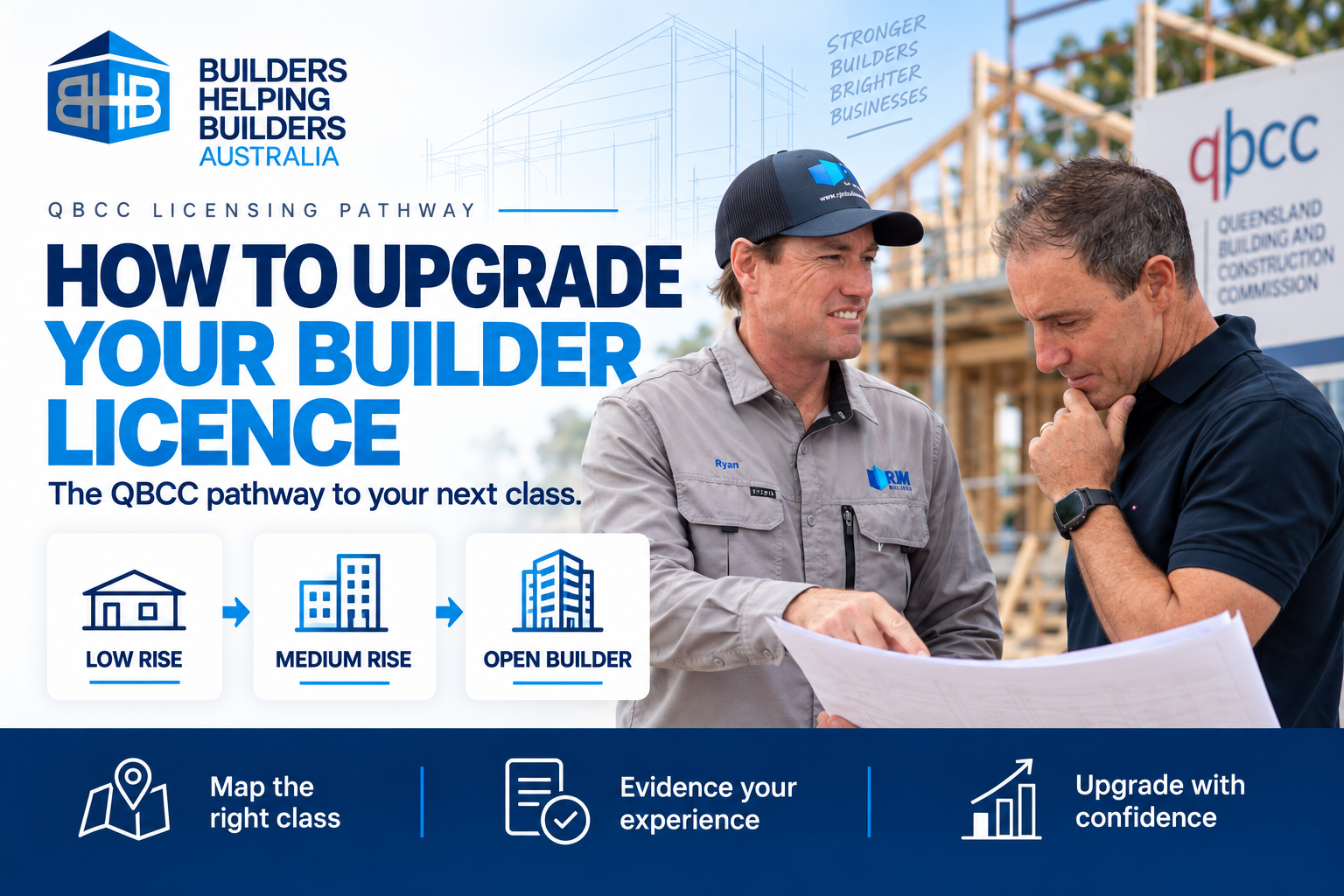

If you are a licensed roofer working across Brisbane and the wider Southeast Queensland market — Brisbane, the Gold Coast, the Sunshine Coast, Logan, Ipswich or Toowoomba — you have probably reached a point where the ceiling of your trade licence is starting to cost you work. You can win the roofer scope on a job, but you cannot hold the head contract. The QBCC Trade Builder Licence Pathway for Roofers is the route that removes that ceiling, and this guide walks through exactly how it works and where the real hurdles sit.
This is not a first-ticket article. It assumes you already hold a QBCC roofer trade contractor licence and genuine on-the-tools experience. What changes when you move up is not your skill — it is the scope of what you are legally allowed to contract for, supervise and take responsibility for as a licensed builder.
What your roofer trade licence lets you do — and where it stops
A QBCC roofer trade contractor licence authorises you to carry out and contract directly for roofer work. That is a real, valuable authorisation, and for many operators it is enough for years. The limit shows up the moment you want to control a whole project rather than one trade within it. You cannot enter into a head building contract, you cannot lawfully supervise other trades under your own licence, and you cannot take on the broader classes of building work that a builder licence covers.
A builder licence changes the equation. Depending on the class you hold, you can contract for and manage the construction of whole buildings — coordinating every trade, carrying the contractual relationship with the client, and taking on the managerial and supervisory responsibility for the build. For a roofer who already understands site sequencing and quality from the ground up, that is a natural progression rather than a leap.
Understanding the difference between a trade contractor authorisation and a full builder authorisation is the first step. The second is understanding which builder class fits the work you actually want to win.
Which builder licence class should a roofer aim for?
Most roofers following the QBCC Trade Builder Licence Pathway for Roofers are targeting a Low Rise builder licence first, because it covers the bulk of detached housing and smaller-scale commercial work in Southeast Queensland.
A Low Rise Builder licence covers Class 1 and Class 10 buildings, plus Class 2 to 9 buildings with a gross floor area of not more than 2,000 square metres, excluding Type A or Type B construction. In practice that means detached homes, townhouses and smaller multi-residential and commercial projects — multi-residential up to three storeys. For a roofer who has spent years on residential and light commercial sites, this is usually the right first target.
Above that sits the Medium Rise Builder licence, which covers Class 2 to 9 buildings up to three storeys. It is the licence you grow into once you have builder-level experience under your belt, not usually the one you jump straight to from a trade licence. If you are weighing the two, our guide on how to move up once you are ready — the low rise to medium rise builder licence upgrade — sets out what that next step involves.
Choosing the wrong class is one of the most common and most costly errors at this stage. Aiming too high means you will not have the experience or evidence to satisfy QBCC; aiming too low means you re-apply sooner than you needed to. Getting the class right before you lodge is exactly what a QBCC licence application review is for.
The experience trap every roofer business owner hits
Here is the problem that stops most roofer business owners in their tracks. To satisfy QBCC for a builder licence, you need to demonstrate genuine building experience gained under appropriate supervision. The conventional way people get that experience is by being employed under a licensed builder who supervises them on qualifying work.
But you already run your own roofer business. You are the owner. You are not going to shut that business down, walk away from your clients, and go and be someone’s employee for the years it takes to log supervised builder-level experience. Being self-employed is exactly what locks you out of the standard employed-under-a-builder route. It is a genuine structural bind: the more established you are as your own boss, the harder the ordinary pathway becomes. This is the single biggest obstacle on the QBCC Trade Builder Licence Pathway for Roofers.
This is the gap the Builders Helping Builders model is built to close. Rather than forcing you to dismantle your own business, we place a licensed nominee supervisor over the relevant building work so you can gain and evidence genuine supervised experience while continuing to run your roofer operation.
That supervision is real, and it is anchored by real credentials. Ryan McMahon of RJM Builders — with more than 30 years of hands-on construction experience — is the licensing authority behind the arrangement. His involvement along with his board of builders is what makes the experience legitimate rather than a paper exercise: genuine supervision means genuine oversight and reasonable availability, not a signature on a form. Because Ryan you have a licensed builders standing behind the work, the experience you build is lawfully supervised and properly evidenced, which is precisely what QBCC looks for on the QBCC Trade Builder Licence Pathway for Roofers.
If you want the detail on how that supervisory relationship actually works day to day, our explainer on what a QBCC nominee supervisor does breaks it down, and the piece on nominee supervisor liability covers what the supervising builder carries on their side of the arrangement.
Evidence: what QBCC actually wants to see
Following the QBCC Trade Builder Licence Pathway for Roofers is one thing; proving your experience to QBCC’s standard is another. This is where applications most often come unstuck, so it is worth being clear-eyed about it early.
QBCC wants lawful, documented evidence of the building work you have been involved in — not just an assertion that you did it. That means contracts, invoices, payment records, site records and referee reports that line up with each other and with the licence class you are applying for. Your referees themselves need to be appropriately licensed and aligned to the class of work they are vouching for. A referee whose own licence does not cover the work being referenced is a common reason an application stalls.
As a roofer, some of your existing project history will count toward this and some will not — trade-only scope on a job does not automatically evidence builder-level responsibility. Sorting what counts from what does not, before you lodge, is far cheaper than having QBCC do it for you and send the application back. On the QBCC Trade Builder Licence Pathway for Roofers, the strength of your evidence is what decides how smoothly it goes. Our overview of the trade business to builder licence upgrade walks through how that experience is assembled and presented, and the guide on how to choose a QBCC nominee supervisor covers what to look for in the builder who will oversee your work.
Business structure: get this right before you lodge
Whether you hold your builder licence personally or through a company changes how you contract, how you carry risk, and how a nominee supervisor sits within the business. Many roofers operate as a sole trader or through a simple company set up years ago for trade work, and that structure is not always the right vehicle for a builder licence.
This is worth deciding deliberately rather than by default. Our guide to QBCC builder licence business structure covers the trade-offs between holding the licence personally, through a company, or within a partnership or trust, and how the nominee arrangement fits each. Getting the structure settled before you apply avoids having to unwind and re-lodge later.
The pathway, step by step
For a licensed roofer in Southeast Queensland, the QBCC Trade Builder Licence Pathway for Roofers follows a consistent shape, even though the detail differs for every applicant:
First, confirm the right builder class for the work you want to win — usually Low Rise to start. Second, get your business structure and nominee arrangement settled so the experience you build is supervised and evidenced correctly from day one. Third, assemble your experience evidence and line up appropriately licensed referees. Fourth, complete a readiness check on the whole application before it goes anywhere near QBCC, so gaps are found and fixed while they are still cheap to fix. Only then do you lodge.
Skipping straight to lodgement is the single most common way roofers waste months. The QBCC Trade Builder Licence Pathway for Roofers rewards preparation, and the applicants who move fastest are almost always the ones who prepared most thoroughly before they lodged.
Where Builders Helping Builders fits
The reason the BHB model works for roofer business owners is simple: it gives you a way to gain genuine supervised builder experience without giving up the business you have already built. You keep running your roofer operation. A licensed nominee supervisor — backed by Ryan McMahon’s experience and oversight — provides the genuine supervision and reasonable availability that QBCC expects, and your experience is documented properly as you go.
That combination is what turns the QBCC Trade Builder Licence Pathway for Roofers from a frustrating dead end into a clear, evidenced route. If you are weighing whether now is the right time, the honest answer for most established roofers is that the ceiling only gets more expensive the longer you wait. Once you commit to it, the work you can win, the contracts you can hold, and the projects you can control all expand at once.
We also help builders who have already made the jump and hit the next set of questions — replacing a departed nominee, or changing licence class. If that is closer to where you are, the guide on how to replace a QBCC nominee that has left and our page on how to change or replace a QBCC nominee supervisor are the right starting points.
Ready to move up?
If you are a licensed roofer across Brisbane, the Gold Coast, the Sunshine Coast, Logan, Ipswich, Toowoomba or Bundaberg and you are ready to start the QBCC Trade Builder Licence Pathway for Roofers, the next step is a licensing readiness check to map your specific position. Start at bhba.com.au and we will help you work out exactly where you stand and what it takes to get there — the plan mapped before you lodge, which is exactly what we do.
Disclaimer
This article is general information only and does not constitute licensing, legal or financial advice. QBCC licensing requirements change and every applicant’s circumstances differ. Always verify current requirements against QBCC’s own published guidance and seek tailored advice for your situation before making an application. Compliance-sensitive guidance in this article is subject to review and sign-off by our licensing authority prior to reliance.