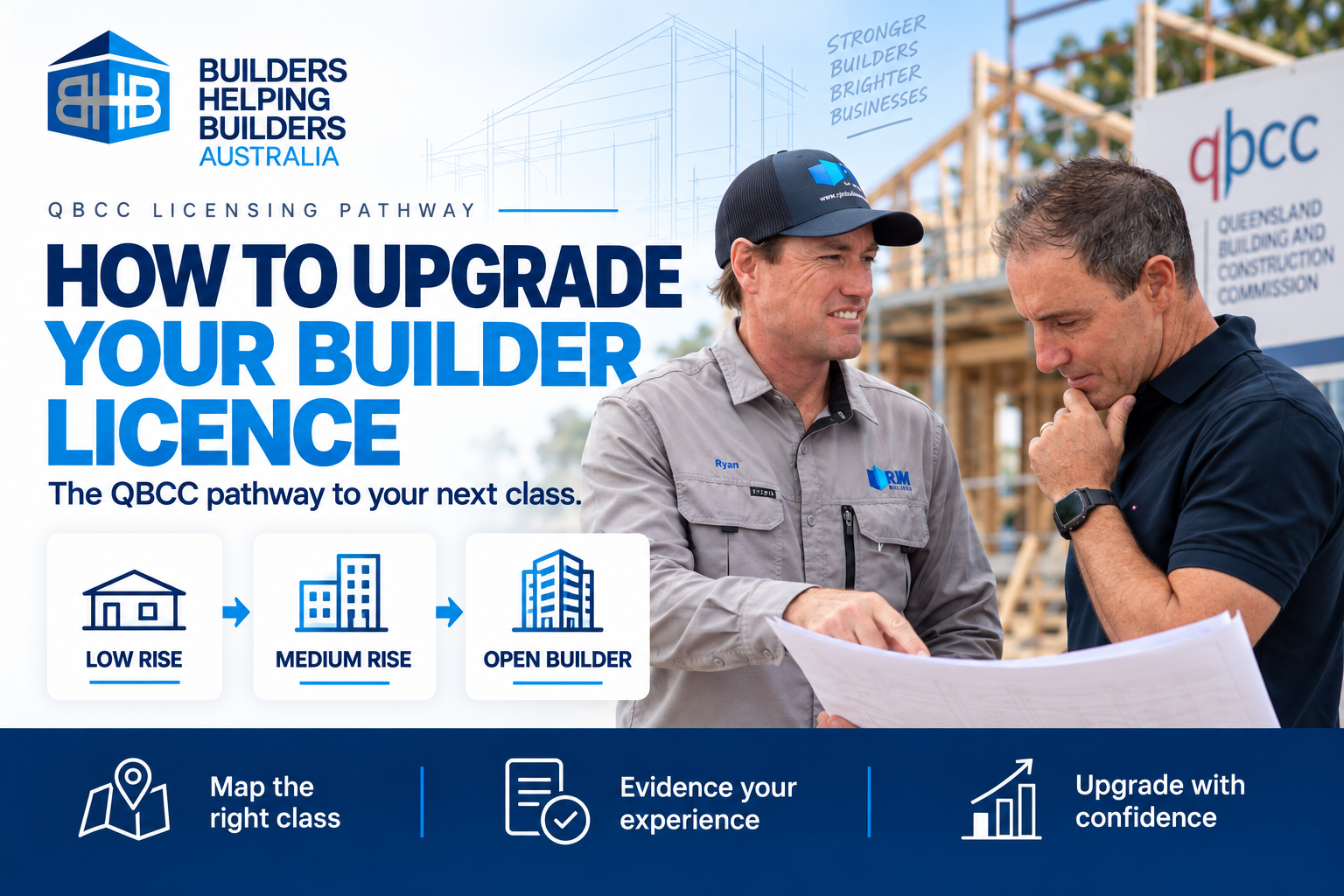
If you already hold a QBCC licence and you are working across Brisbane, the Gold Coast, the Sunshine Coast, Logan, Ipswich, Bundaberg or Toowoomba, at some point you will hit the ceiling of what your current class lets you build. Bigger jobs, taller buildings and larger head contracts all sit behind a higher licence class. This guide explains how to upgrade your builder licence in a way that actually holds up to QBCC scrutiny — the class ladder, the experience the regulator expects, and the practical pathway that gets you from where you are now to the class you are aiming for.
Upgrading is not a form-filling exercise. QBCC wants evidence of genuine building experience at the level you are stepping up to, gained under appropriate supervision. That single requirement is where most upgrade applications either succeed or stall, so it is worth understanding before you lodge anything.
It also pays to be clear about why you are upgrading before you start. A higher class is not automatically better for every business. It comes with a larger scope of work, higher expectations from QBCC, and in most cases a stronger financial position to satisfy the regulator’s minimum financial requirements. The right question is not simply how high you can go, but which class matches the work you actually want to contract for over the next few years. Once that is settled, the pathway becomes a practical sequence rather than a leap.
The QBCC Builder Licence Class Ladder
Before you can plan an upgrade, you need to know exactly where your current class sits and what the next rung actually covers. QBCC builder classes are defined by the building classes under the Building Code of Australia and by the scale of work you are permitted to contract for and supervise.
Low Rise Builder
A Low Rise Builder licence covers Class 1 and Class 10 buildings, plus Class 2 to 9 buildings with a gross floor area of not more than 2,000 square metres, excluding Type A or Type B construction. In practice that includes detached houses, sheds, and multi-residential Class 2 and 3 buildings up to three storeys. It is the most common starting class for trade contractors moving into building.
Medium Rise Builder
A Medium Rise Builder licence covers Class 2 to 9 buildings up to three storeys, taking in Class 4 to 9 up to three storeys. This is the natural next step for a Low Rise builder who wants to take on larger commercial and multi-residential work. If you are weighing this move specifically, the detailed walkthrough on how to upgrade from a Low Rise to a Medium Rise builder licence covers the experience and evidence involved.
Open Builder
An Open Builder licence sits at the top of the class hierarchy and removes the height and floor-area limits of the lower classes. Getting there from Medium Rise is a significant jump in the scale of supervised experience QBCC expects, and the pathway from Medium Rise to Open Builder is worth reading closely before you commit to it.
Why Upgrading Is Really About Experience
The heart of how to upgrade your builder licence is not the paperwork — it is proving you have done building work at the level of the class you want. QBCC assesses upgrade applications on the genuine building experience you have gained, the classes and types of construction you have worked across, and whether that experience was gained under appropriate supervision.
This is where the structural bind catches out a lot of capable builders and trade business owners. The conventional way to gain higher-class experience is to be employed under a licensed builder who already holds that class. But if you run your own business, you cannot realistically shut it down to become someone else’s employee for a couple of years just to tick that box. Being self-employed effectively locks you out of the standard employed-under-a-builder route.
That trap is exactly what a nominee supervisor arrangement is built to solve, and it is central to how to upgrade your builder licence without walking away from the business you have built.
It is worth being honest about what QBCC counts and what it does not. Overlapping projects that ran at the same time are not simply added together. Work that was minor in contract value or scope may not carry the weight of a full building project. And experience gained in a class or type of construction below the one you are targeting does not automatically prove you can handle the step up. Mapping your real project history against the class you want, before you lodge, is what separates a clean upgrade from a knock-back.
How a Nominee Supervisor Closes the Experience Gap
A licensed nominee supervisor is placed over the relevant building work so that you gain and evidence genuine supervised experience at the higher class while continuing to run your own business. You are not handing your projects to someone else. You are structuring the work so that a suitably licensed builder provides genuine supervision, with reasonable availability, over the building work that counts toward your upgrade.
Genuine supervision does not mean the nominee is on site at all times. It means real oversight of the work, reasonable availability to the site and the team, and involvement substantial enough that the experience is legitimate rather than a paper exercise. If you want the full picture of the role, the explainer on what a QBCC nominee supervisor actually does sets it out in plain terms.
At Builders Helping Builders, that credibility is anchored to Ryan McMahon of RJM Builders, who brings more than thirty years of construction experience as the licensing authority behind the arrangement. His involvement is what makes the supervised experience stand up to QBCC assessment. Choosing the right person for this role matters enormously, which is why it is worth understanding how to choose the right QBCC nominee supervisor and where their responsibilities and liability begin and end before anyone signs on.
Getting Your Business Structure Right First
A surprising number of upgrade applications run into trouble not because of experience, but because the licence, the entity and the nominee arrangement are not aligned. Whether you hold your licence personally or through a company changes how the upgrade and any nominee arrangement need to be set up. Working through your QBCC builder licence business structure before you lodge saves you from unwinding a mistake later.
This is particularly important for existing building companies. If your current nominee is leaving, or you need to bring a new one in to support an upgrade, the timing has to be managed so the licence stays active throughout. Existing owners in this position should look at how to replace a QBCC nominee supervisor and, if a nominee has already departed, the steps to replace a nominee who has left without a lapse.
How to Upgrade Your Builder Licence by Starting Point
The exact pathway for how to upgrade your builder licence depends on where you are starting from. The class ladder is the same for everyone, but the experience you already hold and the way your business is structured shape the fastest legitimate route.
Trade contractors moving into building
If you hold a trade contractor licence and want your first builder class, the move is from trade to builder rather than between builder classes. The dedicated guide on how to upgrade your trade business to a builder licence and the overview of the builder licence pathway for trades in QLD walk through the experience and evidence QBCC looks for. A licensed nominee supervisor is often what makes this step possible while you keep trading.
Developers taking head-contract control
If you are a property developer, the question of how to upgrade your builder licence is usually really a question of how to take control of your own head contracts. The pathway for a developer builder licence in QLD and the detail on how to take head-contract control as a developer show how the right builder class and a nominee arrangement let you become the project builder alongside being the developer.
Existing builders stepping up a class
If you already hold a builder class and want the next one up, you are moving along the Low Rise to Medium Rise to Open ladder set out above. Your existing supervised experience is your foundation; the upgrade is about evidencing experience at the new level.
What the Upgrade Application Involves
Once your experience and structure are sorted, the application itself is the final step. Knowing how to upgrade your builder licence includes knowing what QBCC actually asks for: evidence of the building classes and types of construction you have worked across, referee reports from suitably licensed people whose class aligns with your claim, and lawful proof of the experience such as contracts and records. The overview of the QBCC licence application process covers the timelines and steps in detail.
A pre-application roadmap is worth doing before you lodge. A licensing readiness check identifies gaps in your experience, evidence or referees while there is still time to fix them, rather than discovering a shortfall after QBCC has your application. This is the single most effective thing you can do to keep an upgrade on track.
Every upgrade is specific to your history, which is why generic advice only gets you so far. Understanding how to upgrade your builder licence in principle is the starting point; mapping it to your projects, your entity and your target class is where an experienced consultancy earns its place.
The last thing to understand about an upgrade is that momentum matters. Experience gained now, under a properly structured nominee arrangement, is experience you can evidence later. The builders who upgrade smoothly are the ones who set up the right supervision before they need the higher class, not after.
Ready to Map Your Upgrade?
If you want a clear, personalised view of how to upgrade your builder licence from where you are today, book a licensing readiness check with Builders Helping Builders. We will look at your current class, your experience and your business structure, and map the pathway to the class you are aiming for.
Disclaimer
This article is general information only and does not constitute licensing, legal or financial advice. QBCC licensing requirements change and are applied to your specific circumstances, so always verify current requirements against QBCC’s own published pages before acting.