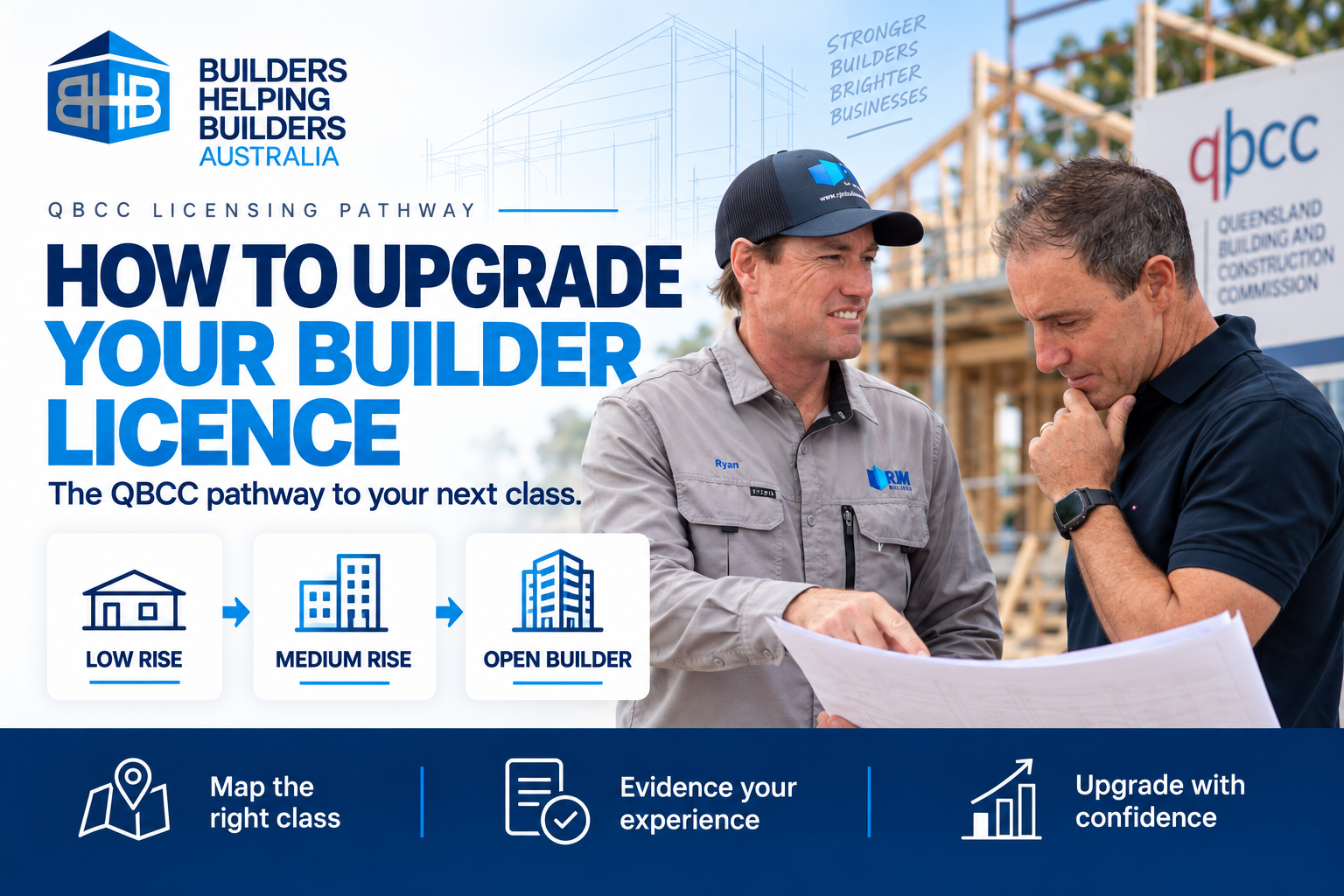

If you’re running a low rise building company in Southeast Queensland — Brisbane, the Gold Coast, the Sunshine Coast — and you keep watching medium rise and commercial projects go to other builders, your licence class is the ceiling.
A Low Rise Builder licence caps you at Class 1 and Class 10 buildings up to three storeys. Building work on classes 2 to 9 buildings with a gross floor area not more than 2000m², but not including Type A or Type B construction.
The moment a project steps above that threshold — a two-storey apartment block, a mid-rise commercial build or fitout, a mixed-use development — you’re locked out of the head contract. Upgrading to a Medium Rise Builder licence removes that ceiling and opens the commercial and multi-residential pipeline that low rise builders can’t touch.
This post explains what the upgrade requires, where most applicants fall short, and how to structure your pathway if you’re serious about making the move.
What Changes When You Move to Medium Rise
A Medium Rise Builder licence covers Class 4–9 buildings up to three storeys, but not including Type A construction under the National Construction Code. In practice, that means:
- Multi-residential apartment buildings (Class 2 & 3) up to three storeys
- Commercial, retail, and office buildings (Class 5–6)
- Industrial, warehouse, factories & carparks buildings (Class 7–8)
- Mixed-use developments combining residential and commercial components
- Aged care, healthcare, and institutional buildings (Class 9)
For a builder currently limited to houses, duplexes, and low-rise residential, this is a substantial expansion in the type of work — and the contract values — available to your business.
The trade-off is that the QBCC’s requirements for a Medium Rise licence are proportionally more demanding than Low Rise. You’re not just doing a paperwork top-up. You need to demonstrate that your experience genuinely extends to the building classes and construction complexity that Medium Rise covers.
What QBCC Requires for a Medium Rise Upgrade
The upgrade pathway from Low Rise to Medium Rise is an application to QBCC for a change of licence class. You’ll need to satisfy three core requirements:
1. Qualifications
For a Medium Rise Builder licence, QBCC requires a qualification at the Diploma of Building and Construction (CPC50220) in Building and Construction (Building) level or higher, with appropriate scope. If you hold a qualification that was sufficient for Low Rise, it may or may not extend to Medium Rise — this depends on the specific units covered and the QBCC’s assessment of equivalency.
In some cases, upgrading qualifications is part of the upgrade pathway. In others, existing qualifications are sufficient with supplementary evidence. This is one of the first things to clarify before you invest time building an experience case.
2. Supervised Construction Experience
This is where most upgrade applications either succeed or fail. QBCC requires documented construction experience on projects that are relevant to the Medium Rise licence class — specifically, buildings that fall within Class 2–9 and are of a scale and complexity appropriate to the licence.
Key requirements include:
- Time in a supervisory role — you need to demonstrate experience as the person responsible for supervising the construction, not just working on site
- Project classes and types — your projects must include Class 2–9 buildings, not just Class 1 residential
- Non-overlapping projects — QBCC does not allow simultaneous projects to both count toward your experience time. This is one of the most common issues in upgrade applications
- Documentation — contracts, site records, council approvals, and referee confirmation of your supervisory role. Invoices and payslips alone are rarely sufficient for an upgrade application
If your experience to date has been primarily Class 1 residential under your Low Rise licence, you’ll need a deliberate plan to accumulate Class 2–9 experience before applying.
3. Referee Reports
Your referees must hold a QBCC licence that is appropriate to the work they are verifying. For a Medium Rise upgrade, a referee who holds only a Low Rise licence cannot verify Class 4–9 experience. Referee suitability — licence class, currency, and alignment to the projects being referenced — is consistently flagged as a problem in licence upgrade applications.
The Role of a Nominee Supervisor in a Licence Upgrade
Here’s the situation many low rise builders find themselves in: they have the drive and the business capacity to take on medium rise work, but they don’t yet have the personal experience to qualify for a Medium Rise licence in their own right.
A QBCC nominee supervisor arrangement solves this.
If your company engages a nominee supervisor who holds a Medium Rise (or Open Builder) licence, your company can carry out Medium Rise building work immediately — while you, as the director, accumulate the personal supervisory experience required to eventually apply for your own Medium Rise licence.
This isn’t a loophole. It’s the intended function of the nominee supervisor framework. QBCC’s licensing structure explicitly allows companies to operate above the director’s personal licence class, provided a suitably licensed nominee is in place.
For a builder looking to break into the commercial and multi-residential market, this arrangement means:
- Your company can bid and win Medium Rise projects now
- You manage those projects in a genuine supervisory capacity, building experience toward your personal upgrade
- Your nominee provides the licence coverage and oversight required under Section 43 of act by QBCC
- Over time, you document that experience and apply for your own Medium Rise licence
At Builders Helping Builders, we place experienced QBCC nominee supervisors with building companies across Southeast Queensland who are making exactly this transition. The arrangement is structured to keep your projects fully compliant while you build the experience record you need.
Common Pitfalls in Low Rise to Medium Rise Upgrade Applications
Overlapping project timelines. If you were supervising Class 2 – 9 projects simultaneously and claiming both toward your experience, QBCC will only count one. Many builders don’t realise this until they calculate their eligible experience and find themselves well short.
Project scale not meeting the threshold. Not every Class 2 building qualifies equally. A small duplex walkup and small apartment block both sit in Class 2, but QBCC’s assessors look at complexity, contract value, and scope of supervisory responsibility. Small-scale Class 2 projects may not adequately demonstrate the competency expected for a Medium Rise licence.
Based on what we see in upgrade applications, these are the issues that most commonly delay or derail the process:
Referees holding Low Rise licences only. If the people who can vouch for your Class 2–9 experience only hold Low Rise licences themselves, their referee reports carry significantly less weight. Referee selection for an upgrade application needs to be deliberate and planned early.
Targeting the wrong class. Some builders discover mid-process that Open Builder is actually the appropriate target for the work they want to do — or that their experience is better aligned to a specific Medium Rise subclass. Getting clarity on the right target licence class before you build your evidence case saves considerable time and rework.
Insufficient documentation. Supervisory experience needs to be substantiated — contracts, approvals, site supervision records, and documentary evidence of your role. A statutory declaration from a referee without supporting project documentation is rarely sufficient on its own.
How Long Does the Upgrade Take?
There’s no fixed answer because it depends on where you’re starting from. Two variables drive the timeline:
1. How much relevant experience you already have. If you’ve been working on Class 2–9 projects under your current Low Rise licence (via a nominee arrangement) and have been documenting your supervisory role carefully, you may be closer to eligible than you think. If you’ve been doing exclusively Class 1 residential, you’ll need a structured experience-building period before applying.
2. Application processing time. Once your application is lodged, QBCC’s processing timeframes vary. Having a complete, well-documented application with no gaps is the best way to avoid requests for further information that add weeks to the process.
A licensing readiness check is the most efficient way to get a clear picture of where you currently sit, what gaps exist, and what a realistic upgrade timeline looks like for your specific situation.
Frequently Asked Questions
Can I apply for Medium Rise directly, without holding a Low Rise licence first? Yes. The Low Rise licence is not a mandatory prerequisite for Medium Rise — you can apply for Medium Rise directly if you have the qualifications and experience to support it. However, for most builders, the Low Rise pathway is the natural progression.
Does my company lose the ability to do low rise work once I upgrade? No. A Medium Rise Builder licence includes the scope of a Low Rise licence. Upgrading adds work you can do — it doesn’t remove anything.
Can I take on commercial projects while waiting for my upgrade application to be processed? Yes, if your company has a nominee supervisor who holds a Medium Rise or Open Builder licence. The nominee arrangement covers your company’s licence class independently of your personal licence status.
What is the difference between Medium Rise and Open Builder? Medium Rise covers Class 2–9 buildings up to three storeys, but not including Type A construction. Open Builder has no height restriction and covers all Type A,B & C building classes. If you’re targeting high-rise residential or large-scale commercial projects, Open Builder is the relevant class. The experience and qualification requirements are more demanding again.
What happens if I start taking on Medium Rise work without a licence or nominee? This is unlawful under the Queensland Building and Construction Commission Act. Penalties are significant, and carrying out unlicensed building work also creates serious exposure on defects liability and Home Warranty Insurance. There is no practical argument for working outside your licence class when the nominee arrangement provides a straightforward, compliant solution.
Ready to Map Your Upgrade Pathway?
If you’re a building company owner in Southeast Queensland and you’re ready to move from low rise into the commercial and multi-residential market, the first step is understanding exactly where your current experience and qualifications sit against QBCC’s Medium Rise requirements.
Our licensing readiness check will give you a clear assessment of your position, identify the gaps, and map a practical pathway forward — whether that’s placing a nominee supervisor to start taking on medium rise work immediately, or building your personal experience record toward a direct upgrade application.