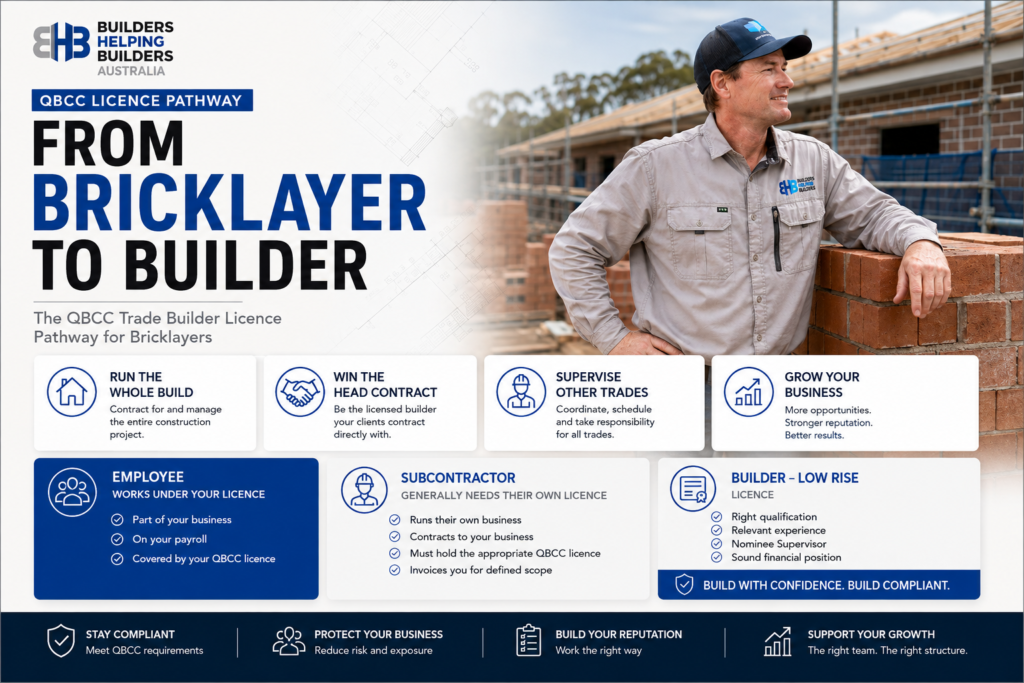
QBCC Trade Builder Licence Pathway for Bricklayers. You already hold a QBCC bricklaying trade contractor licence. You are not chasing a first ticket. What you are chasing is the authority to run the build, not just the brickwork, and that is a change in legal scope rather than a change in skill.
You lay the shell. Why can’t you contract the build?
Here is the frustration in plain terms. Your masonry is structural. On a lot of jobs the brickwork is the building, at least in the sense that everything else is fixed to it or sits inside it. But your trade contractor licence authorises bricklaying work, full stop. It does not let you enter a head building contract, it does not let you take legal responsibility for the trades that follow you, and it does not let you contract for the classes of building work a builder licence covers.
A builder licence flips that. You go from being the trade that lays the walls to the entity that contracts for, coordinates and carries responsibility for the whole build. The chippies, the roofers, the waterproofers, the fit-out trades that all come after your courses are up become trades you manage rather than trades you work alongside. For a bricklayer who has spent years watching a build take shape from the slab up, that oversight is familiar ground.
It helps to picture the change concretely. On your own jobs today, the carpenters, roofers, waterproofers, renderers and fit-out trades work around you. As the builder, those become trades you engage, schedule and answer for. The relationships do not disappear, but the direction of responsibility flips: instead of turning up to lay brick to someone else’s program, you set the program and carry the contract that everyone else works under. For a bricklayer who has spent years reading how a build fits together, that is a change of role more than a change of trade.
The class most bricklayers should target first
Most bricklayers moving along the QBCC Trade Builder Licence Pathway for Bricklayers are aiming at a Low Rise Builder licence to begin with. It matches the detached housing and smaller multi-residential work that makes up the bulk of masonry-heavy building in Southeast Queensland.
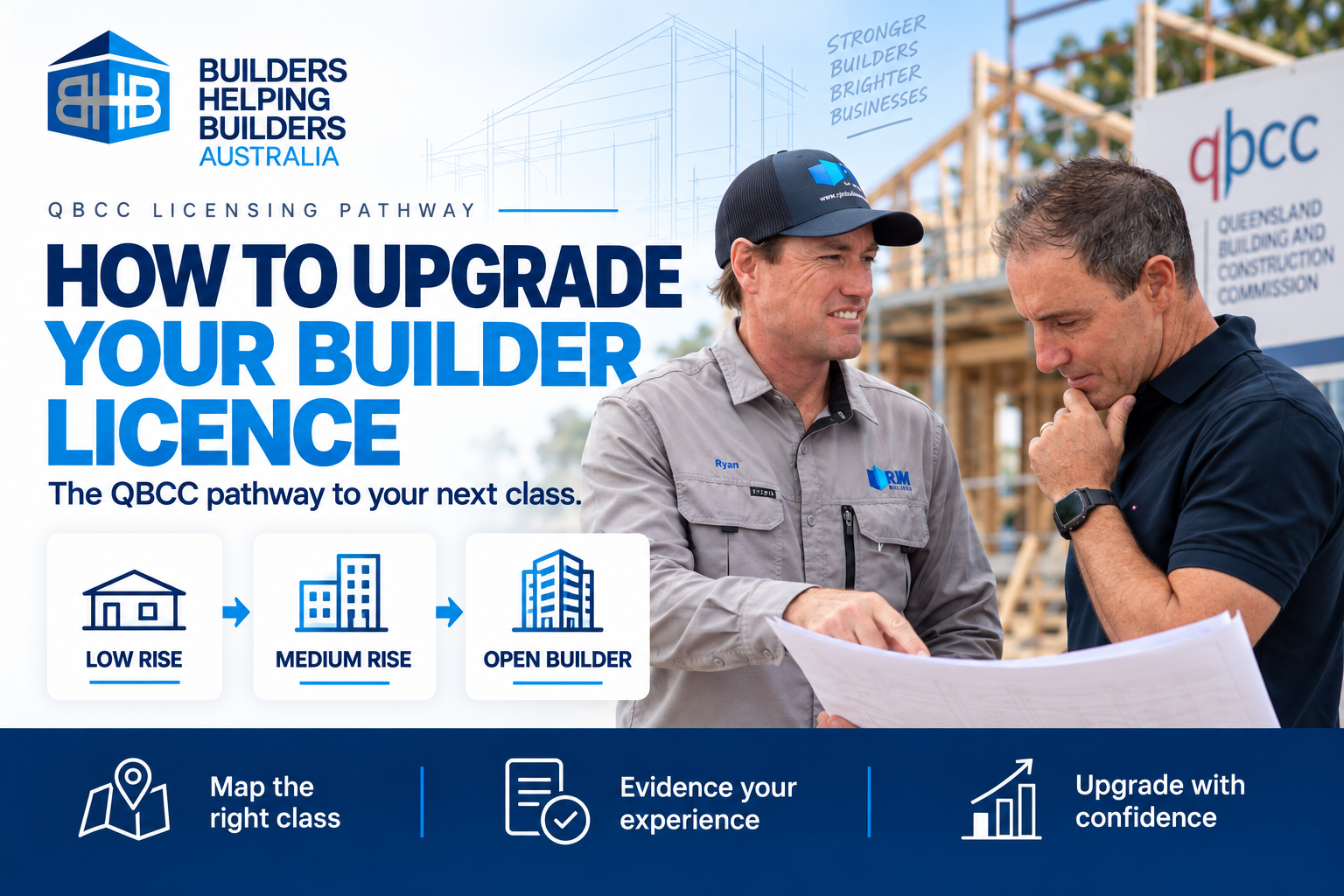
A Low Rise Builder licence covers Class 1 and Class 10 buildings, plus Class 2 to 9 buildings with a gross floor area of not more than 2,000 square metres, excluding Type A or Type B construction, with multi-residential up to three storeys. That range captures brick-and-block homes, townhouse rows and small walk-up unit blocks. The next rung, the Medium Rise Builder licence, covers Class 2 to 9 buildings up to three storeys and is where you head once you have builder-level experience behind you; our guide on the low rise to medium rise builder licence upgrade sets out that later step.
Pick the class deliberately. Getting it right before you lodge is what a QBCC licence application review is for, and it saves re-lodging when QBCC decides the target was wrong.
The wall every self-employed bricklayer runs into
This is where most bricklayers stall, and it has nothing to do with how well you lay brick. QBCC wants to see genuine building experience gained under proper supervision before it hands over a builder licence. The ordinary way to get that supervision is to be employed under a licensed builder who oversees you on the work.
But you run your own bricklaying business. You have blokes on the tools, jobs booked out, clients who call you directly. Nobody sensible is going to down tools, put the business on hold and go and be someone’s employee for a couple of years just to tick the supervision box. That is the wall on the QBCC Trade Builder Licence Pathway for Bricklayers: being your own boss is the exact thing that shuts you out of the standard employed-under-a-builder route.
The Builders Helping Builders model was built to get around that wall without knocking your business down. A licensed nominee supervisor sits over the relevant building work, so you gain and evidence genuine supervised experience while you keep running your bricklayer operation and keep the income coming in.
That supervision is real, and it is backed by someone with the history to stand behind it. Ryan McMahon of RJM Builders, with more than 30 years in construction, is the licensing authority behind the arrangement. Genuine supervision means genuine oversight and reasonable availability, not a name lent to a form. Because a licensed builder is genuinely standing behind the work, the experience you log is lawfully supervised and properly documented, which is exactly what QBCC checks for on the QBCC Trade Builder Licence Pathway for Bricklayers. If you want the mechanics, our explainer on what a QBCC nominee supervisor does and the piece on nominee supervisor liability cover both sides of it.

What counts as evidence, and what QBCC waves away
Proving the experience is where masonry business owners often trip. As a bricklayer, plenty of your history is trade-scope brickwork, and trade-scope work does not automatically demonstrate builder-level responsibility for a whole project. Evidence is the real test on the QBCC Trade Builder Licence Pathway for Bricklayers: QBCC wants documented proof, meaning contracts, invoices, payment records and referee reports that line up with each other and with the licence class you are seeking.
Your referees matter as much as your records. A referee has to be appropriately licensed and aligned to the class of work they are vouching for, or the reference does not carry weight. Sorting which of your jobs actually evidences builder-level involvement, before you lodge, is far cheaper than QBCC sending it back. Our overview of the trade business to builder licence upgrade walks through assembling that history, and how to choose a QBCC nominee supervisor covers picking the builder who will oversee you.
There is a liability dimension worth understanding too. As a trade contractor you are responsible for your brickwork. As a licensed builder holding the head contract you carry responsibility for the whole structure, including the work of every trade under you and the statutory warranty obligations that attach to residential building work in Queensland. That is a real step up in exposure, and it is one of the reasons QBCC is careful about who it grants a builder licence to. Going in with your eyes open about what you are taking on, not just what you are gaining, is part of making the move well rather than fast.
Sort your business structure before you apply
Holding the licence personally or through a company changes how you contract, how you carry risk, and how a nominee sits inside the business. A lot of bricklayers are running a sole-trader setup or a company put together years ago for trade invoicing, and that is not always the right vehicle for a builder licence. Settling this early is an easy win on the QBCC Trade Builder Licence Pathway for Bricklayers. Our guide to QBCC builder licence business structure lays out the options so you sort it before lodging rather than unwinding it afterwards.
The move, in order
For a Southeast Queensland bricklayer, the QBCC Trade Builder Licence Pathway for Bricklayers runs in a sensible order. Confirm the builder class that fits the work you want, usually Low Rise. Get your structure and nominee arrangement in place so experience is supervised and recorded correctly from the first job. Gather your evidence and line up licensed referees. Run a readiness check across the whole application so gaps surface while they are cheap to fix. Then lodge.
Rushing straight to lodgement is how bricklayers lose months. The QBCC Trade Builder Licence Pathway for Bricklayers rewards the ones who prepare, and preparation is the cheapest part of the whole exercise.
Where BHB comes in
The reason the BHB approach suits bricklayer business owners is that you never have to stop being one. You keep laying brick and running jobs while a licensed nominee, backed by Ryan McMahon’s oversight, provides the genuine supervision and reasonable availability QBCC expects, with your experience documented as you go. That is what turns the QBCC Trade Builder Licence Pathway for Bricklayers from a dead end into a mapped route.
If you have already made the jump and are dealing with a nominee change instead, the guide on how to replace a QBCC nominee that has left and our page on how to replace a QBCC nominee supervisor are the right starting points.
Ready to run the whole build?
If you are a licensed bricklayer across Brisbane, Ipswich, Logan, the Gold Coast, the Sunshine Coast, Toowoomba or Bundaberg and you want to start the QBCC Trade Builder Licence Pathway for Bricklayers, the next step is a licensing readiness check that maps your position. Head to bhba.com.au and we will work out where you stand and what it takes to hold the contract, not just lay the walls.

Disclaimer
This article is general information only and is not licensing, legal or financial advice. QBCC requirements change and every applicant’s circumstances differ. Always confirm current requirements against QBCC’s own published guidance and seek tailored advice before applying. Compliance-sensitive guidance here is subject to review and sign-off by our licensing authority before it is relied on.