
For builders and trade business owners across Brisbane, the Gold Coast, the Sunshine Coast, Logan, Ipswich, Toowoomba and Bundaberg, a Builder—Low Rise licence opens up a broad scope of work and lets many of your employees work under your company’s licence. But some trades always need their own licence. This guide sets out the licence types involved, which trades sit outside a builder’s cover, and the pathway to upgrade.
The licence types that matter
Start with the licence types. A Builder—Low Rise licence is a builder’s licence covering a broad scope of building work. A trade contractor licence covers a single trade. Separate to both is occupational licensing, which applies to specific higher-risk work. The key point for this article is simple: for that higher-risk work, an occupational licence QBCC builder cover cannot replace, and it must be held by the individual doing the work.
What a Builder—Low Rise licence covers
QBCC defines the Builder—Low Rise scope as building work on Class 1 and Class 10 buildings, building work on Classes 2 to 9 buildings up to 2,000 square metres of gross floor area excluding Type A or Type B construction, and non-structural building work generally. For the ordinary building trades inside that scope, such as carpentry, formwork, bricklaying, tiling, plastering and painting, your genuine employees can generally work under the company’s licence with genuine supervision behind them.
The table below sets out the common building trades on each side of the line. On the left are trades that a genuine employee can generally carry out under the company’s Builder—Low Rise licence, with appropriate supervision. On the right are trades where the individual must hold their own licence regardless of who employs them.
| Employee can generally work under the company’s Low Rise licence | Individual must hold their own licence |
| Carpentry | Plumbing |
| Timber framing | Drainage |
| Fix-out carpentry | Gas fitting |
| Formwork | Mechanical services |
| Concreting | Fire protection |
| Bricklaying and blocklaying | Chemical termite management |
| Wall and floor tiling | Electrical (separate legislation) |
| Plastering and plasterboard | Waterproofing |
| Painting and decorating | |
| Joinery and cabinet installation | |
| Roof tiling |
A few trades sit closer to the line and are not listed above because the answer depends on the exact work involved. Roof and wall cladding, metal fascia and guttering, structural steel, glazing and landscaping that forms part of a build can each fall inside or outside the position depending on the specific job and any occupational licensing that attaches to it. Treat these as needing confirmation against current QBCC guidance before you rely on them, rather than assuming they are covered.
The trades that always need their own occupational licence
Certain work is occupationally licensed because of the safety and public-interest risk involved. For these trades the individual carrying out or supervising the work must hold the relevant licence of any value, no matter who they work for. No occupational licence QBCC builder cover replaces it:
- Plumbing and drainage — requires the individual to hold a plumbing and drainage occupational licence.
- Gas fitting — requires an occupational gas work licence, issued outside the QBCC framework.
- Fire protection — specific fire protection occupational licensing applies.
- Mechanical services — occupational licensing applies to this work.
- Chemical termite management — requires the relevant occupational licence.
QBCC’s own example makes it clear: a licensed plumber who employs another plumber does not need that employee to hold a QBCC contractor licence, but the employee still needs their occupational plumbing licence to do the work. The occupational licence QBCC builder distinction attaches to the individual and the work, not the company’s builder licence.
Electrical work sits under separate legislation
Electrical work is worth noting separately because QBCC does not govern it. Electrical licensing in Queensland sits under separate electrical safety legislation. A Builder—Low Rise licence has no bearing on who can carry out electrical work, so an occupational licence QBCC builder discussion does not reach electrical work at all. Your electricians need their own electrical licences under that separate regime.
What this means for your team
The practical rule is clean. For the ordinary building trades inside your Low Rise scope, your genuine employees can generally work under the company’s licence. For the occupational trades, the individual must hold their own licence regardless of how they are engaged, and no occupational licence QBCC builder cover changes that. Knowing where the line sits protects your business from unlicensed work ending up on your projects, and from the liability that comes with it.
Why occupational trades are treated this way
It helps to understand the reasoning. The building trades that can work under a company’s builder licence are ones where the company’s overall supervision and licensing give QBCC enough assurance about quality. The occupational trades are different. Faulty plumbing, unsafe gas work, a failed fire system or a botched termite treatment can put lives and public health directly at risk, and the fault can be invisible until something goes badly wrong. Queensland therefore attaches the licence to the individual, so there is always a qualified, accountable person behind the work. No occupational licence QBCC builder cover can substitute for that individual accountability, and once you see the reasoning the boundary makes sense.
This is also why the requirement holds regardless of the value of the work. For ordinary building work a dollar threshold decides when a licence is needed, but for the occupational trades a licence is required for work of any value, because the risk is in the nature of the work rather than its size. Keeping the occupational licence QBCC builder boundary in mind helps you apply it correctly on every job, not just the large ones.
A quick checklist before you put someone on a job
When you are deciding whether a worker can operate under your company’s builder licence or needs their own, three questions cover most situations:
- Is the work an ordinary building trade inside my Low Rise scope? If yes, and the worker is a genuine employee with genuine supervision, they can usually work under the company licence.
- Is the work occupational, such as plumbing, gas, fire, mechanical services or termite management? If yes, the individual needs their own occupational licence, and no occupational licence QBCC builder cover changes that.
- Is the work electrical? If yes, it sits under separate electrical safety legislation and QBCC licensing does not reach it.
Run through those three and you avoid the most common trap, which is assuming a builder’s licence is a blanket that covers every worker on site. It covers a great deal, but the occupational trades sit outside it by design. Applying the check at the point you take someone on, rather than after the work is done, is the simplest way to keep every job compliant and to keep the liability for unlicensed work off your business.
The pathway to upgrade
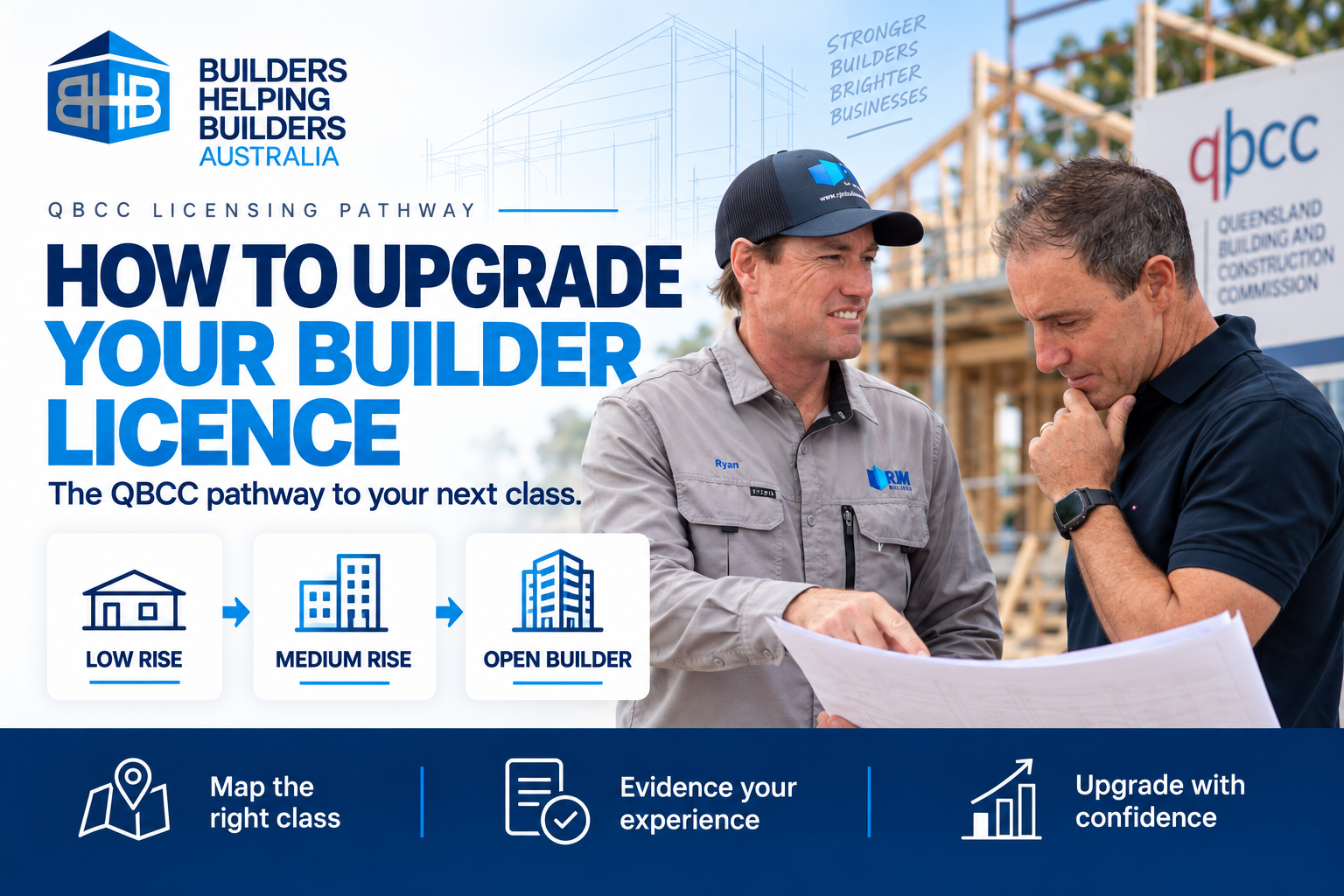
If you are a trade business owner working toward holding a Builder—Low Rise licence yourself, the pathway involves the right qualification, enough relevant construction experience at the right level, evidence of that experience, a sound financial position, and an appropriate nominee supervisor. Once the licence is in place, you can run a build and bring the ordinary building trades under your cover, while the occupational trades continue to hold their own licences. Understanding the occupational licence QBCC builder boundary before you get there means you plan your team correctly from day one.
The experience and evidence are usually the parts that need the most planning. QBCC looks for genuine construction experience across a suitable range of work, backed by records such as contracts, invoices and references. Building those records as you go, rather than reconstructing them later, is what keeps an application moving. Mapping where you stand against the requirements early turns the upgrade from a vague ambition into a clear, achievable plan.
If your growth is pushing toward larger or more complex projects, you may also be looking at how to upgrade from a low rise to medium rise builder licence, which brings its own scope and experience considerations. Either way, the builder licence pathway for trades QLD is the place to start.

Incidental work and grey areas
Some tasks sit near the boundary and deserve care rather than assumption. A small amount of work that is genuinely incidental to another licensed trade can sometimes be treated differently from the same work done as a standalone job, and the precise rules around incidental work are detailed. Rather than guess, the safe approach is to treat anything touching the occupational trades as requiring the relevant licence unless you have confirmed otherwise against current QBCC guidance. The cost of assuming wrongly is far higher than the cost of checking, so when a job sits close to the line, a quick confirmation before work starts is always worth it.
It is also worth remembering that these boundaries can change over time. QBCC updates its scopes, thresholds and provisions from time to time, so a position that was correct a year ago may have shifted. For anything you rely on when planning a team or an application, checking the current QBCC guidance rather than working from memory or an old summary keeps you on solid ground and protects the work you have already put in.
Talk to Builders Helping Builders
Builders Helping Builders helps builders and trade business owners across Southeast Queensland get the full picture before they scale. We can run a licensing readiness check on your licence, your scope and how you plan to staff your projects, and map a clear pathway forward. Head to bhba.com.au to book your pre-application roadmap.
Appendix: Full trade reference list
The list below sets out the common trades and how each generally sits under a Builder—Low Rise company licence. Covered means a genuine employee can generally carry out the work under the company’s licence with appropriate supervision. Own licence required means the individual must hold the relevant occupational or trade licence regardless of who employs them. Depends means the position turns on the exact work and should be confirmed against current QBCC guidance before you rely on it.
| Trade | Position under a Builder—Low Rise company licence |
| Carpentry | Covered |
| Timber framing | Covered |
| Fix-out carpentry | Covered |
| Formwork | Covered |
| Concreting | Covered |
| Bricklaying and blocklaying | Covered |
| Wall and floor tiling | Covered |
| Plastering and plasterboard | Covered |
| Painting and decorating | Covered |
| Joinery installation | Covered |
| Cabinet installation | Covered |
| Roof tiling | Covered |
| Roof and wall cladding | Depends on the specific work |
| Metal fascia and guttering | Depends on the specific work |
| Structural steel erection | Depends on the specific work |
| Glazing | Depends on the specific work |
| Landscaping forming part of the build | Depends on the specific work |
| Waterproofing | Own licence required |
| Plumbing | Own licence required |
| Drainage | Own licence required |
| Gas fitting | Own licence required |
| Mechanical services | Own licence required |
| Fire protection | Own licence required |
| Chemical termite management | Own licence required |
| Electrical | Own licence required (separate legislation) |
For a complete breakdown of which building trades a Builder—Low Rise company can have its employees carry out, and which trades require the individual to hold their own occupational licence, see our full QBCC Builder—Low Rise Employee Trade Scope Guide.
General Disclaimer
This article is general information for Queensland builders and trade business owners and is not legal or licensing advice. Occupational licensing requirements and scopes of work change from time to time, and electrical licensing is administered separately under Queensland electrical safety legislation. Always confirm current requirements with QBCC and the relevant regulator directly, and seek tailored advice before making decisions about your licence or your team.