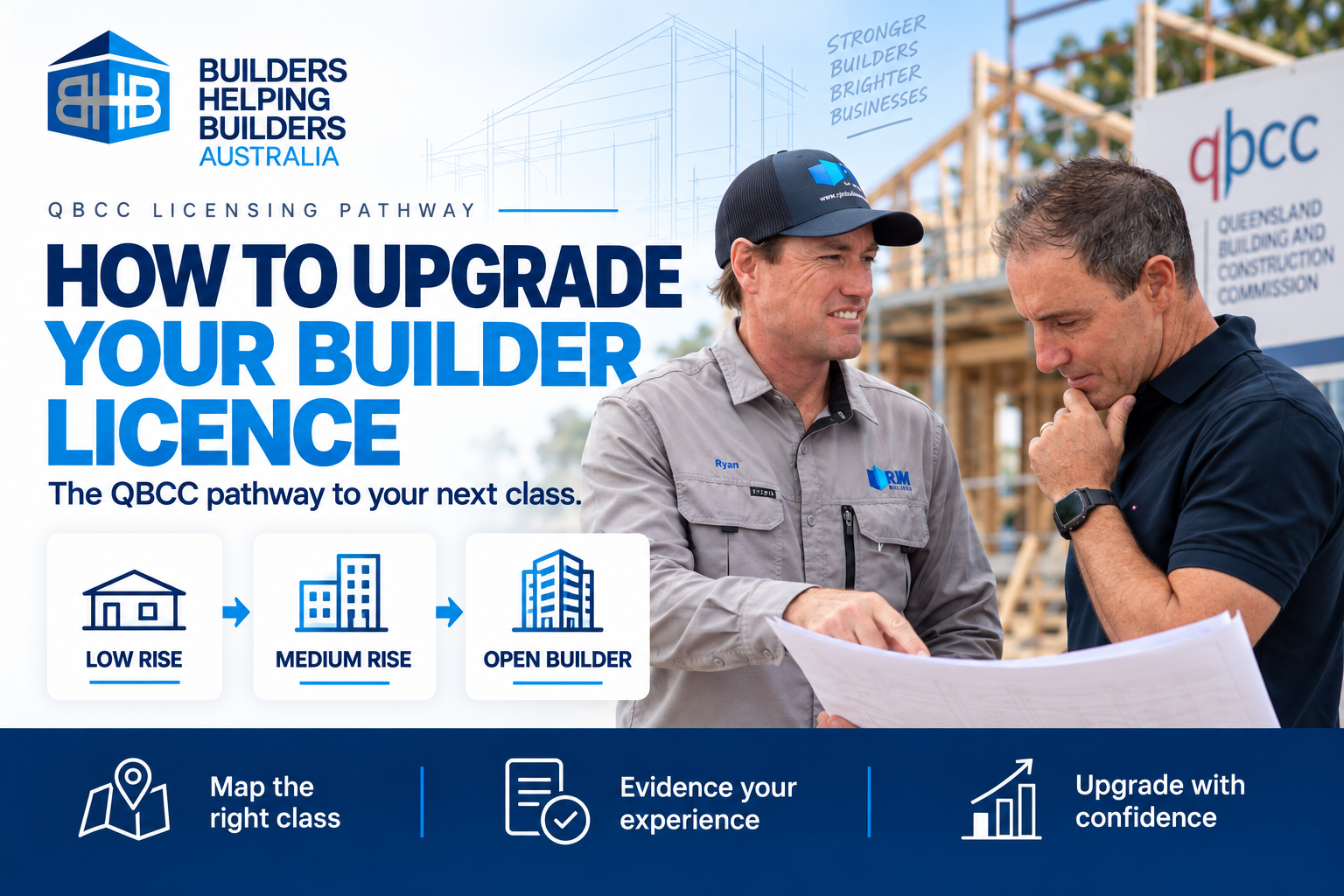
For builders across Brisbane, the Gold Coast, the Sunshine Coast, Bundaberg, Logan, Ipswich and Toowoomba, stepping up from a low rise to medium rise builder licence is one of the most common growth moves in the industry. It opens the door to a broader class of buildings and larger projects, and for many Southeast Queensland businesses it is the natural next stage of expansion. But the QBCC does not grant the upgrade automatically. You have to demonstrate that you meet a defined set of requirements first.
This guide is a plain-English checklist of what the upgrade actually asks of you: the experience you need to show, the evidence that backs it up, the financial thresholds, and the nominee considerations. If you want the step-by-step process itself, our step-by-step upgrade from low rise to medium rise walkthrough covers that; this article focuses on whether you qualify in the first place.
What the Upgrade Actually Gives You
Before you weigh the requirements, it helps to be precise about what a low rise to medium rise builder licence lets you do that a low rise licence does not. Getting this right also stops a common misconception in its tracks.
A Low Rise Builder licence covers Class 1 and Class 10 buildings, plus Class 2 to 9 buildings with a gross floor area of not more than 2,000 square metres, excluding Type A or Type B construction. In multi-residential terms, that reaches Class 2 and Class 3 buildings up to three storeys.
A Medium Rise Builder licence extends your scope to Class 2 to 9 buildings up to three storeys, covering Class 4 to 9 up to three storeys. This is the point where accuracy matters: the Medium Rise class in Queensland is defined around a three-storey limit, not the eight-storey figure that is sometimes quoted in error. When you assess whether a low rise to medium rise builder licence suits your goals, base that decision on the correct three-storey scope so you are not planning around work the class does not actually authorise.
Requirement 1: Relevant Experience at the Right Level
The core of any application to move up a class is demonstrated experience. The QBCC wants to see that you have managed and supervised building work of the type and complexity the higher class involves, not just that you have held a licence for a period of time.
That means experience across the relevant building classes and types of construction under the Building Code of Australia, with genuine supervisory responsibility rather than a peripheral role. Overlapping projects that cannot each be counted separately, or projects that are minor in nature, tend to fall short of what the higher class requires. The practical test is whether your project history genuinely reflects medium rise complexity and whether your scope of responsibility on those projects was at the appropriate level.
If your experience to date sits mostly within low rise work, part of planning the upgrade is identifying where you can gain or evidence the additional experience the class demands.
Requirement 2: Lawful, Sufficient Evidence
Experience only counts if you can prove it. A frequent stumbling block on the path to the higher class is insufficient or poorly organised evidence. The QBCC expects lawful documentation of the experience you claim, which can include contracts, invoices, payment records, and other project documentation that ties you to the work and to your supervisory role.
Referees are part of this too. Your referees need to be appropriately licensed and aligned with the class you are seeking, and their own licence currency matters. A referee who cannot speak to medium rise-level work, or whose licence does not align, weakens the application. Getting the evidence and referee picture right before you lodge is far easier than trying to repair it mid-assessment. Our overview of the QBCC licence application process explains how evidence is assessed more broadly.
Requirement 3: Meeting the Financial Thresholds
The upgrade is not only about experience. Taking on larger projects usually means a larger turnover, and the QBCC ties your permitted revenue to your financial position through the Minimum Financial Requirements framework. Your Net Tangible Assets must support the maximum revenue your business expects to earn in the higher class.
If moving up a class will lift your turnover beyond your current category, you may need to adjust your financial category and provide the supporting financial reporting. Planning this in advance avoids a situation where your experience qualifies you but your financial category does not keep pace. Our guide to the QBCC minimum financial requirements sets out how NTA and maximum revenue interact, and it is worth reading before you lodge.
Requirement 4: Nominee and Structure Considerations
If you hold your licence through a company, the class held by your company and the class held by your nominee must align. Upgrading from a low rise to medium rise builder licence at the company level means your nominee must hold the corresponding class as well. This is easy to overlook, and it can quietly stall an otherwise strong application.
It is also a moment to make sure your nominee arrangements are sound. Genuine supervision and reasonable availability are central to the role, and the higher class carries higher expectations. If you need to review or change your nominee as part of the upgrade, our explainer on what a QBCC nominee supervisor does and our guide to nominee supervisor liability cover the responsibilities, and the replace QBCC nominee supervisor service page covers the practical side of making a change.
Timing Your Application
When you lodge matters as much as whether you qualify. The strongest applications are the ones where experience, evidence, financial category, and nominee alignment are all in place at the same time. Lodging while any one of these is still a work in progress tends to slow the assessment and invites requests for further information. It is usually better to spend a little longer getting every element aligned than to lodge early and have the application stall.
A useful rule of thumb is to treat the readiness checklist below as a gate. If you cannot yet answer yes to each item, you are not quite ready to lodge, and the time between now and then is best spent closing those gaps deliberately rather than hoping the assessor overlooks them.
A Quick Readiness Self-Check
Before you commit to a low rise to medium rise builder licence application, run through this short self-check. If you can answer yes to each, you are in strong shape. If not, you have a clear list of what to work on.
- Does your project history genuinely reflect medium rise complexity and building classes, with you in a real supervisory role?
- Can you evidence that experience lawfully, with contracts, invoices, payment records, and aligned referees?
- Does your financial position, and your category, support the revenue you expect in the higher class?
- If you licence through a company, does your nominee hold, or can they obtain, the matching class?
- Have you accounted for the ongoing obligations that come with a larger business, including the QBCC continuous reporting requirements that apply once you are operating at the higher level?
The Roadblock Most Company Directors Hit
There is a very common pattern in Queensland building companies, and it catches good operators off guard. In most low rise companies, the director is also the QBCC nominee supervisor. That works perfectly well at the low rise level: the tradesperson earns their low rise builder licence, builds a successful business, and takes on quality work within the class.
The trouble comes when the business is ready to grow into larger projects but the director is not yet able to upgrade their own personal licence. The reason is almost always the same. Moving from a low rise to medium rise builder licence at the personal level requires demonstrated medium rise supervision experience, and a director who has only ever supervised low rise work simply does not have it yet. The business is ready. The director is stuck. The company cannot take on medium rise projects because the person who holds the licence cannot satisfy the higher experience requirement, and the director cannot gain that experience because the company is not yet licensed to do the work. It is a genuine chicken-and-egg problem, and it stalls a lot of otherwise capable businesses.
How to Break the Deadlock
This is exactly the situation the Builders Helping Builders model is built to solve, and it turns the roadblock into a structured pathway. Rather than waiting years for experience the director has no way to gain, the company engages an experienced medium rise QBCC nominee supervisor on a short-term basis. With a qualified nominee in place, the company can upgrade its licence and lawfully commence medium rise projects straight away.
The important part is what happens during that period. The engaged nominee provides genuine, hands-on supervision of the company’s medium rise work and, in doing so, mentors the director on site. The director gains real medium rise supervision experience under that nominee, along with the documented evidence of that work that a future personal licence application depends on. This is genuine supervision and real experience, not a name on a form, and that distinction is what keeps the arrangement sound and compliant.
Because the goal is the director’s own licence, the nominee arrangement is designed as a bridge rather than a permanent fixture. Over time, the director accumulates the qualifying supervision experience and evidence they need, and can then pursue their own upgrade to the higher class. The business keeps growing throughout, the director progresses toward holding medium rise personally, and the company is never held back by the experience gap that stopped it in the first place. If this is the position you are in, our guidance on how to choose a QBCC nominee supervisor and how to find a QBCC nominee supervisor sets out how the arrangement works in practice.
Who Typically Makes This Move
This step up tends to suit two kinds of business. The first is the established low rise builder whose clients are asking for larger or more complex projects, and who does not want to turn that work away or refer it on. The second is the growing building business that has already reached the low rise level and sees medium rise as the next rung.
If you are in the second group and still consolidating your builder-level credentials, our guidance on how to upgrade your trade business to a builder licence and the builder licence pathway for trades QLD service page are the right foundations to build from. Developers weighing how licence class fits their project ambitions will find the developer builder licence QLD pathway a useful companion. And if medium rise is only a stepping stone toward the top class, our guide to the medium rise to open builder licence path shows what comes after.
Find Out If You Qualify
Moving from a low rise to medium rise builder licence is a significant step, and the difference between a smooth upgrade and a stalled one usually comes down to how well you meet these requirements before you lodge. If you want a clear, honest read on where you stand against the experience, evidence, financial, and nominee requirements, a licensing readiness check with Builders Helping Builders will identify exactly what you have covered and what still needs work.
Book your licensing readiness check through bhba.com.au and approach your upgrade with a clear plan.