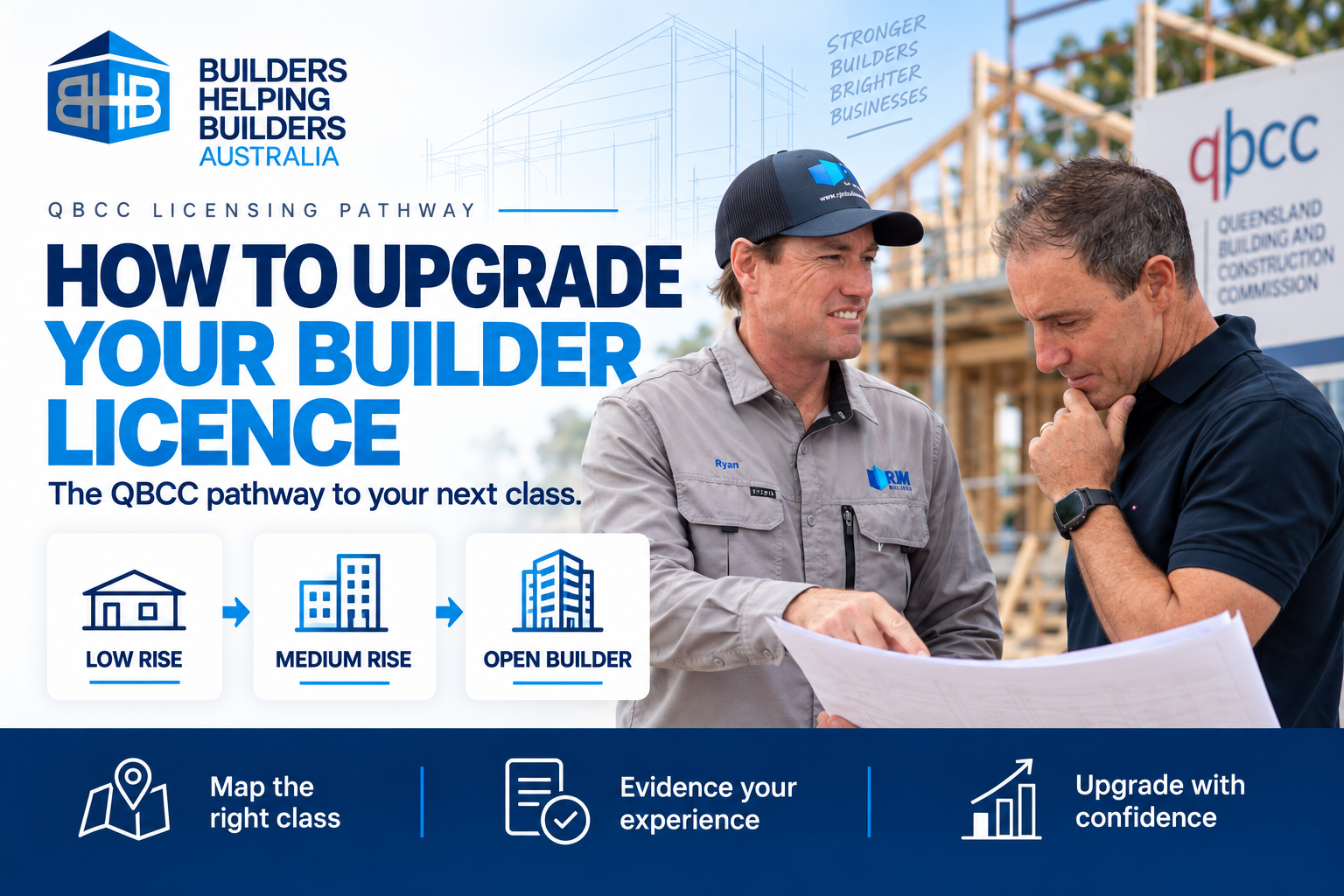
For trade business owners across Brisbane, the Gold Coast, the Sunshine Coast, Logan, Ipswich, Toowoomba and Bundaberg, one of the biggest reasons to move up from a trade contractor licence to a QBCC Builder—Low Rise licence is scope. A builder’s licence lets you contract for a full build, and it lets you employ tradespeople under builder licence cover rather than needing every worker to hold their own ticket. This guide sets out the licence types involved, what the licence lets you do, and the pathway to upgrade.
The licence types that matter
There are two licence types to be clear on. A trade contractor licence covers one trade, such as carpentry. It lets you contract for and carry out work in that trade only. A Builder—Low Rise licence is a builder’s licence held by a company or individual. It covers a broad scope of building work, and it is the licence that lets you run a build and employ tradespeople under builder licence cover across that scope.
The step from one to the other is the step from being a tradesperson to being a builder. It is what allows you to take on head contracts and bring a team under your own licence.
What a Builder—Low Rise licence lets you do
QBCC defines the Builder—Low Rise scope as building work on Class 1 and Class 10 buildings, building work on Classes 2 to 9 buildings up to 2,000 square metres of gross floor area excluding Type A or Type B construction, and non-structural building work generally. In plain terms that covers houses, townhouses, duplexes, sheds, garages and a range of smaller commercial and multi-residential work up to three storeys.
Because that scope is far wider than any single trade, it is the foundation for building a team. Once your company holds the licence, you can employ tradespeople under builder licence cover to carry out the ordinary building trades inside that scope, all under the one licence.
How the employee cover works
QBCC states that in most cases a person does not need their own licence if they are carrying out building work as an employee of a licensed contractor. That is what makes it possible to employ tradespeople under builder licence cover. Your genuine employees can carry out building work inside your licensed scope without each holding a separate contractor licence.
QBCC gives a plain example: a licensed painter who employs three painters does not need those employees to hold individual licences to paint a house. The same principle lets a licensed builder employ carpenters, formworkers, bricklayers and general hands to work under the company’s licence.
The one condition is genuine supervision. Someone appropriately licensed, usually your nominee supervisor, has to be genuinely responsible for the work, with real oversight and reasonable availability. If you are not clear on that role, our guide to what a QBCC nominee supervisor does explains it. When you employ tradespeople under builder licence cover, that supervision is what keeps the arrangement sound.

The trades that keep their own licence
The cover is broad but not unlimited. Some work is occupationally licensed, meaning the individual doing it must hold the relevant licence regardless of who employs them. That includes plumbing, drainage, gas fitting, fire protection, mechanical services and chemical termite management. Electrical work sits under separate electrical safety legislation entirely. You cannot employ tradespeople under builder licence cover for these occupational trades. Their licences stay with the individual.
A practical example
Picture a carpenter in Logan who has run a solid trade business for years on a carpentry contractor licence. On that licence they are limited to carpentry. They upgrade the company to a Builder—Low Rise licence with an appropriate nominee. Now the company can contract to build a full house, and it can bring on a team to handle the framing, the fix-out, the formwork and the general labouring, all under the one company licence.
What changed is not the carpenter’s skills. It is the licensed footprint of the business and the ability to bring a team under it. That is the shift a builder’s licence unlocks, and it is why many trade business owners across Southeast Queensland see the upgrade as the point their business stops being a single-trade operation and becomes a builder.
Employees versus subcontractors
One distinction is worth being clear on. The employee cover applies to genuine employees. It does not extend to subcontractors. If a separate business invoices your company as a subcontractor to carry out building work, that subcontractor generally needs to hold its own appropriate contractor licence. So a carpenter working as your PAYG employee can work under your licence, while the same carpenter invoicing you through their own business generally needs their own carpentry licence. If you plan to employ tradespeople under builder licence cover as a way to grow, keep that line clear from the start.
What counts toward the upgrade
The experience side of the upgrade is usually where planning pays off. QBCC looks for relevant construction experience at the right level, across a suitable range of building work, backed by evidence such as contracts, invoices and references. Experience in a single narrow trade may not be enough on its own to demonstrate the breadth a builder’s licence expects, so it is worth understanding the gap early and working to close it deliberately rather than discovering it at application time.
Getting the evidence in order is as important as the experience itself. Well-organised records of the projects you have run, the work involved and your role on each make the difference between a smooth application and a stalled one. When that groundwork is done, the licence is the payoff at the end of a proper application, not a shortcut around it.
Planning the move
The best time to think about all of this is before you need it. If you know you want to grow into a builder who employs a team, you can start shaping your projects, your records and your qualifications toward that goal now, rather than scrambling when the opportunity arrives. A trade business owner who plans the upgrade deliberately tends to reach it faster and with fewer surprises than one who leaves it to chance.
The pathway to upgrade
Reaching the point where you can employ tradespeople under builder licence cover means holding the Builder—Low Rise licence, and that means meeting QBCC’s requirements. In broad terms the pathway involves the right technical qualification, enough relevant construction experience at the right level, evidence of that experience, a sound financial position, and an appropriate nominee supervisor standing behind the company’s work.
For a trade business owner, the experience and evidence are usually the parts that need the most planning. The qualification can be studied for, but the experience has to be genuine and properly documented over time, ideally as you go rather than reconstructed later from memory. Mapping where you stand against those requirements early is what turns the goal into a realistic, achievable plan, and the builder licence pathway for trades QLD is the place to start if you are weighing up that step.
Why the scope matters commercially
The commercial case for the upgrade is straightforward. As a single-trade contractor you are one link in someone else’s build, paid for your slice of the work. As a licensed builder you can hold the head contract, control the programme, and capture the margin on the whole job rather than just your slice of it. Bringing a team under your own licence is what makes that possible at scale, because once you can employ tradespeople under builder licence cover you are no longer dependent on a chain of separately licensed subcontractors for every task. For many trade business owners, that shift in position is the difference between steady work and real growth, and it is worth planning toward well before you are ready to apply so the move is smooth when the time comes and the licence is in place when you need it.
Talk to Builders Helping Builders
Builders Helping Builders works with trade business owners across Southeast Queensland who want to make this move. We can run a licensing readiness check on where your experience and structure sit, and map a clear pathway to a builder’s licence. To get started, head to bhba.com.au and book your pre-application roadmap.
General Disclaimer
This article is general information for Queensland trade business owners and is not legal or licensing advice. QBCC licensing requirements, scopes of work and exemptions change from time to time, and how they apply depends on your circumstances. Always confirm current requirements with QBCC directly, and seek tailored advice before making decisions about your licence, your staff or your business structure.