
If you run a growing trade or building business across Brisbane, the Gold Coast, the Sunshine Coast, Logan, Ipswich, Toowoomba or Bundaberg, how you engage the people who do your work is a licensing question as much as a payroll one. The employee vs subcontractor QBCC distinction decides who can work under your licence and who needs their own. This guide sets it out plainly, along with the licence types involved and the pathway to upgrade to a builder’s licence.
The licence types that matter
Two licence types frame this. A trade contractor licence covers a single trade and lets the holder contract for and carry out that trade. A Builder—Low Rise licence is a builder’s licence covering a broad scope of building work, held by the company or individual running the build. The employee vs subcontractor QBCC question is about who can work under that builder’s licence, and who has to hold a licence of their own.
Employees can work under your licence
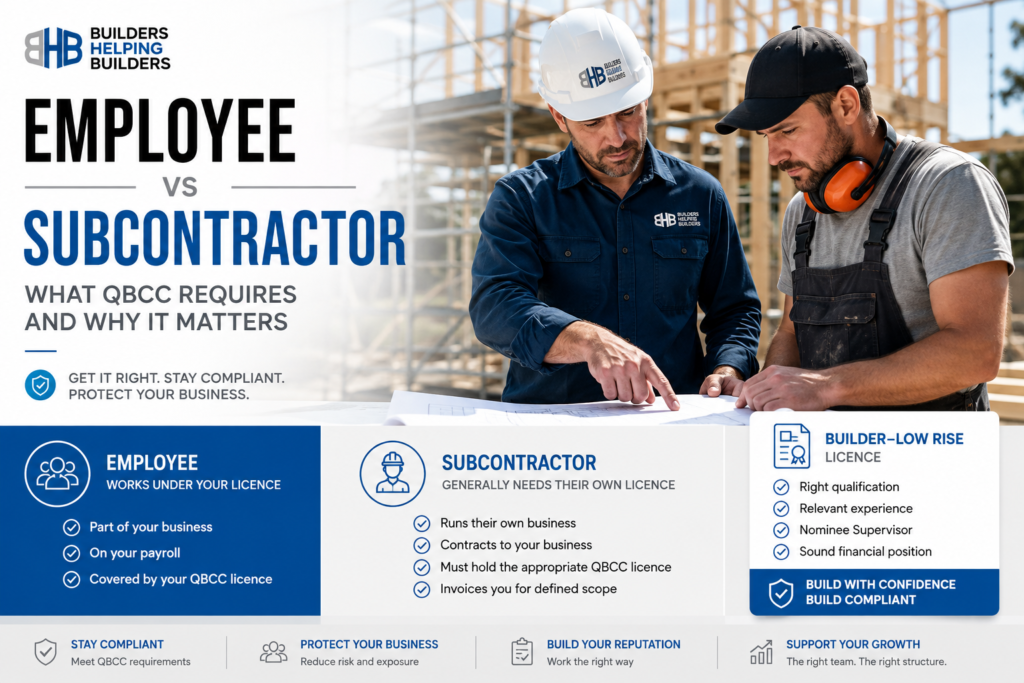
QBCC states that in most cases a person does not need their own licence if they are carrying out building work as an employee of a licensed contractor. That is the core of the employee vs subcontractor QBCC distinction. Your genuine employees can carry out building work inside your company’s licensed scope without each holding a separate contractor licence, because they work under their employer’s licence.
QBCC’s own example is a licensed painter who employs three painters. Those employees do not need individual QBCC licences to paint a house. They are covered by the employer’s licence for the work they carry out.

Subcontractors generally need their own licence
A subcontractor is different. When a separate business contracts to your company to carry out building work, it is an independent contractor, and a subcontractor generally needs to hold its own appropriate contractor licence for the building work it performs. This is the other half of the employee vs subcontractor QBCC distinction.
So the same carpenter can be in two positions. As your employee, they work under your licence. Trading as their own business and invoicing you as a subcontractor, they generally need their own carpentry contractor licence. The work is the same. The licensing is not.
Why the distinction matters as you grow
When you take on help, the employee vs subcontractor QBCC question becomes live. Businesses often reach for subcontractors for flexibility, but if those subcontractors do licensed building work without their own licence, the arrangement can be non-compliant even when everyone is skilled and well-meaning. The distinction turns on the real nature of the working relationship, not the label on the paperwork, and QBCC looks at substance.
Getting it right protects you. If unlicensed building work is carried out on your project by someone who should have been licensed, the consequences can land on your company. Occupational trades add a further limit: plumbing, drainage, gas, fire protection, mechanical services and termite work always require the individual to hold the relevant occupational licence, however they are engaged. Whichever model you choose, someone appropriately licensed still has to genuinely supervise the work.
A worked example
Take a builder on the Sunshine Coast delivering a townhouse project who needs carpenters on site. There are two clean ways to do it. The first is to employ the carpenters directly as PAYG staff, in which case they can carry out carpentry under the company’s licence with the company’s nominee supervising. The second is to engage a separate carpentry business as a subcontractor, in which case that business generally needs to hold its own carpentry contractor licence. Both are legitimate. The employee vs subcontractor QBCC line simply decides which set of rules applies, and the arrangement on paper needs to match what actually happens on site.
Problems arise when the two are blurred. A worker treated as a subcontractor for invoicing but managed like an employee, or an unlicensed contractor doing licensed building work on the assumption they are covered, is where a business drifts into non-compliance. Thinking through the employee vs subcontractor QBCC question up front avoids that drift entirely.
Getting the paperwork to match reality
Whichever model you choose, the documentation should reflect what is really happening. Genuine employees should be on your payroll, working under your direction and using your systems. Genuine subcontractors should be running their own businesses, carrying their own licences where the work requires it, and quoting for defined scopes. When the paperwork and the reality line up, your position is clear and defensible. When they diverge, you invite questions you would rather not face.
This is not only a QBCC concern. The same employee vs subcontractor QBCC line runs through tax, superannuation and workers compensation. A worker who is genuinely an employee brings obligations in all of those areas, and treating them as a subcontractor to sidestep those obligations creates exposure well beyond licensing. Building your team on an honest footing from the outset saves a great deal of difficulty later.
The pathway to upgrade
If your plan is to build a team working under your own licence, the pathway is to upgrade to a Builder—Low Rise licence. In broad terms that means the right qualification, enough relevant construction experience at the right level, evidence of that experience, a sound financial position, and an appropriate nominee supervisor. Once that licence is held, genuine employees can work under it with genuine supervision behind them, which is usually the cleanest way to grow.
Planning that upgrade early pays off. The experience QBCC looks for has to be genuine and built up over time, and the evidence, such as contracts, invoices and references, is easier to assemble as you go than to reconstruct later. A trade business owner who understands the employee vs subcontractor QBCC position and plans the upgrade deliberately tends to reach a builder’s licence faster and with fewer surprises than one who leaves it to chance.
Because the employee vs subcontractor QBCC position flows from how your business is structured, it is worth setting up correctly from the start. Our guide to how business structure affects your QBCC builder licence goes deeper, and the builder licence pathway for trades QLD covers the upgrade itself.

Occupational trades sit outside this entirely
One more limit is worth stating plainly. Some work is occupationally licensed no matter how the worker is engaged. Plumbing, drainage, gas fitting, fire protection, mechanical services and chemical termite management all require the individual to hold the relevant occupational licence, and electrical work sits under separate electrical safety legislation. Neither being an employee nor working under a company builder’s licence changes that. So when you plan your team, treat the occupational trades as a separate category: those workers carry their own licences regardless, and the question of employee or subcontractor does not remove that requirement. Keeping that clear alongside everything else stops a well-run growth plan from tripping on a technicality, and it is one of the first things worth confirming for each role before work starts on site.
Why this protects you
It is easy to read licensing rules as red tape, but the distinction exists partly to protect you as the licensed business. If unlicensed building work is carried out on your project by someone who should have held a licence, the consequences can land on your company, and if defective work needs rectifying, the question of who was licensed to do it becomes very real. Understanding the rule is a way of keeping your own risk under control as you take on more people and more projects. That is why it is worth getting right from the first hire, not something to sort out once you have grown.
Common situations where the line gets blurred
A few patterns come up often as businesses grow. The first is the long-term subcontractor who, over time, works only for you, on your schedule, under your direction, using your equipment. On paper they invoice you, but in substance the relationship looks like employment, and that mismatch is exactly what draws scrutiny. The second is the mate who helps out on jobs without any clear arrangement at all, which leaves everyone exposed if something goes wrong. The third is the skilled worker doing licensed building work in their own name without holding the licence for it, on the assumption that working for a licensed business is enough.
None of these are unusual, and none are necessarily done in bad faith. They tend to grow out of a small operation informally taking on more work. But each one is worth tidying up as you scale, because the informal arrangement that was fine for one job becomes a real risk across a team of ten. A short review of how each person on your projects is engaged, and whether that matches reality, is time well spent.
Talk to Builders Helping Builders
Builders Helping Builders helps trade and building business owners across Southeast Queensland get these decisions right. We can run a licensing readiness check on your structure, your licence and how you engage your team, and map a clear pathway forward. Whether you are hiring your first employee or preparing to upgrade to a builder’s licence, getting the foundations right early saves costly corrections later. Head to bhba.com.au to book your pre-application roadmap.
General Disclaimer
This article is general information for Queensland trade and building business owners and is not legal, employment or licensing advice. Whether a worker is an employee or a subcontractor depends on the true nature of the arrangement, and QBCC licensing requirements change from time to time. Always confirm current requirements with QBCC directly, and seek tailored advice before making decisions about how you engage workers or structure your business.