
If you’re based in Brisbane, the Gold Coast, the Sunshine Coast, or anywhere else in Southeast Queensland and you’re weighing up a QBCC licence application, it pays to know exactly what you’re walking into before you start. The process itself is well-defined, but it’s also unforgiving of gaps in evidence, mismatched referees, or an unrealistic timeline. This guide walks through what actually happens once you submit, how long it genuinely takes, and where most applicants run into trouble.
What Triggers an Application in the First Place
Most people preparing a QBCC licence application fall into one of three groups. Trade contractors who already hold a current trade licence and want to move up to a builder licence so they can run their own projects, rather than working under someone else’s supervision. Property developers who want head-contractor control instead of paying margin to an external builder on every job. And existing building company owners who need to add or change a licence class as their business grows into different building types, or who need to bring on a new nominee supervisor.
Whichever group you fall into, the underlying assessment process is the same. What changes is the evidence you’re building toward and the licence class you’re aiming for.
Step-by-Step: How the Process Actually Works
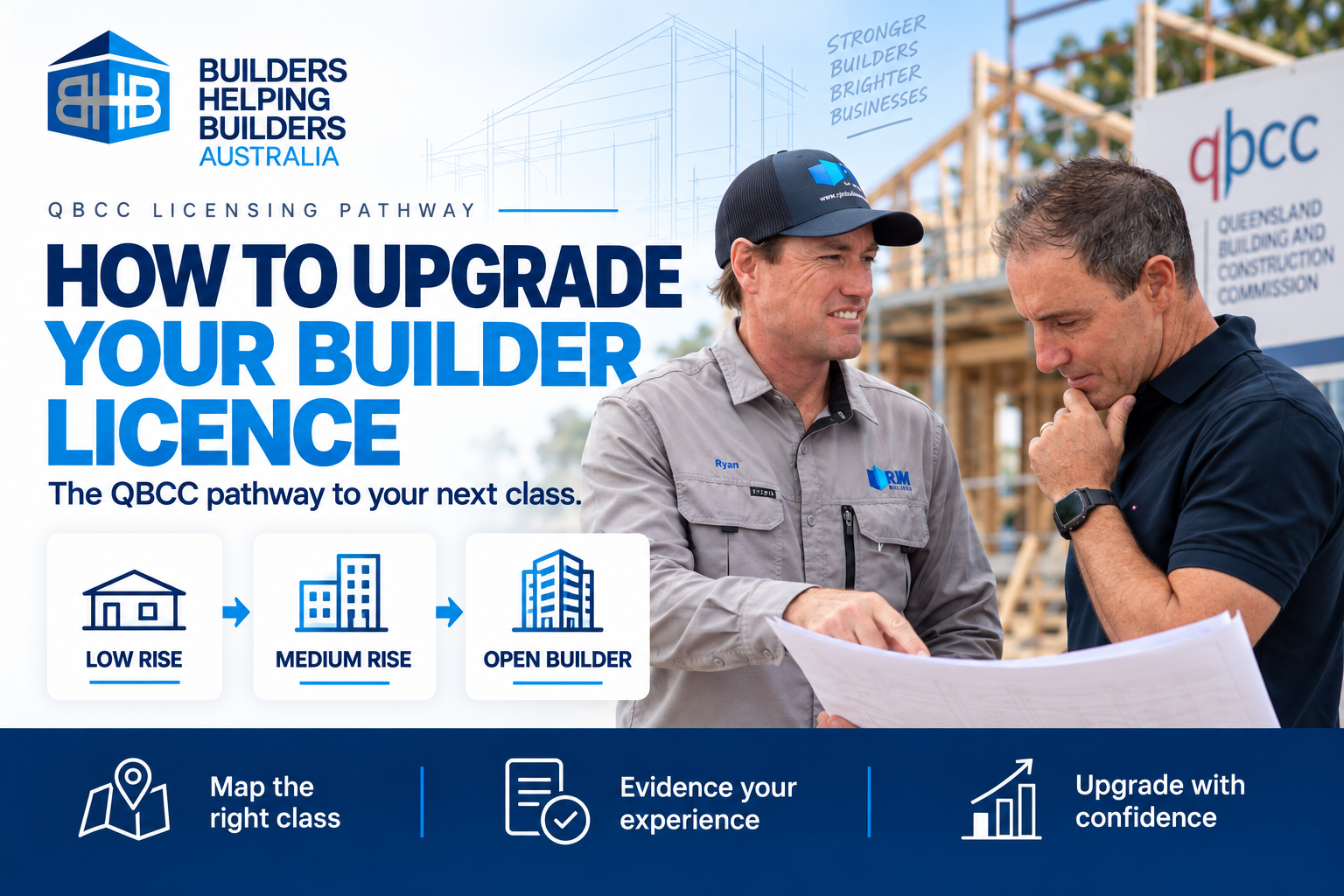
Step 1 — Confirm the right licence class. Before anything else, work out whether you’re aiming for a Low Rise Builder, Medium Rise Builder, or Open Builder licence. Low Rise covers Class 1 and 10 buildings, plus Class 2 to 9 buildings with a gross floor area no greater than 2,000 square metres, excluding Type A or Type B construction, and multi-residential buildings up to three storeys. Medium Rise covers Class 2 to 9 buildings up to three storeys — not eight, despite what some older guidance suggests. Open Builder removes the storey and class restrictions entirely. Getting this wrong at the outset is one of the most expensive mistakes you can make, because it wastes months of evidence-gathering aimed at the wrong target.
Step 2 — Gather your qualifications and experience evidence. The QBCC wants documented, verifiable experience that aligns with the licence class you’re applying for. This means project records, payslips or invoices, and a clear written account of your scope of responsibility on each job — not just a list of sites you happened to work on. Vague or generalised experience claims are one of the fastest ways to slow things down.
Step 3 — Line up your referees. Referees need to hold a licence at the same class or higher, and their statements need to genuinely match your claimed experience and scope. Mismatched, unsuitable, or lapsed referees are one of the most common reasons an application stalls at assessment stage, so this step deserves more attention than most applicants give it.
Step 4 — Confirm your nominee and business structure. If you’re applying through a company, partnership, or trust, the QBCC needs to see who your nominee supervisor is and exactly how the licence will sit within your business structure. Developers moving into head-contractor territory and building company owners replacing a departing nominee both need this sorted before lodgement, not during it.
Step 5 — Lodge and respond promptly to any requests for information. Once submitted, the QBCC may come back with requests for clarification or additional evidence. How quickly and thoroughly you respond has a direct and often underestimated impact on your overall timeline.
Realistic Timelines
There’s no single fixed turnaround time for a QBCC licence application, because timelines depend heavily on how complete your evidence is at the point of submission. A well-prepared application with strong referee statements and clean documentation moves through assessment noticeably faster than one that requires multiple rounds of clarification. As a general pattern, applicants who arrive with gaps — incomplete project history, referees who aren’t appropriately licensed, or unclear scope of work — should expect a longer process than those who’ve done the groundwork first. This is precisely why most of the delay in a typical application sits in the preparation stage, not the QBCC’s own assessment turnaround. It’s also why two applicants targeting the same licence class, in the same region, can have dramatically different experiences — one moving through cleanly in a matter of weeks, the other stuck in back-and-forth correspondence for months, purely because of how complete their evidence was on day one.
Common Reasons Things Get Delayed
A handful of recurring issues account for most of the delays we see in practice:
-
- Overlapping projects that cannot be counted toward the required experience, because the work happened at the same time as another job already claimed.
-
- Projects that are considered minor contracts rather than substantial building work, and therefore do not count toward a full builder licence application.
-
- Insufficient documentary evidence, such as missing invoices, payslips, or bank records to back up claimed experience.
-
- Referees who are not appropriately licensed, or whose own licence has lapsed since the work was completed.
-
- Targeting the wrong licence class for the work actually being carried out, which often only becomes apparent partway through assessment.
-
- Inconsistent or unclear understanding of what the QBCC is actually assessing at each stage, which leads to under-prepared evidence.
None of these are fatal on their own. They’re simply the most common reasons an application takes longer than it needs to, and nearly all of them are fixable well before lodgement if you catch them early enough.
Where a Licensing Readiness Check Fits In
Because so many delays come down to evidence and referee issues that are entirely avoidable, a licensing readiness check before you lodge is one of the most effective ways to shorten your overall timeline. Rather than discovering a gap after submission — when fixing it means restarting parts of the clock — a readiness check looks at your qualifications, experience, referees, and business structure against the specific licence class you’re targeting, and flags anything that needs to be addressed before you lodge a QBCC licence application.
This matters slightly differently depending on your situation. A trade contractor moving up to a builder licence is usually short on documented supervisory experience rather than hands-on trade work. A developer aiming for head-contractor control is usually missing the formal project-management evidence the QBCC wants to see, even though they’re running developments day to day. A building company owner managing a licence class change or replacing a nominee supervisor is usually working against a deadline, because an existing licence can be put at risk while the gap sits open. Each of these pathways has its own evidence requirements, and getting clarity early avoids wasted months later.
Frequently Asked Questions
How long does a QBCC licence application actually take?
It varies considerably depending on how complete your evidence is at the time of lodgement. Applications with strong, well-documented evidence and appropriately licensed referees move through assessment far more smoothly than those needing multiple rounds of clarification.
Can I apply for more than one licence class at the same time?
You can only hold the licence class your evidence currently supports. Many applicants start with Low Rise Builder and upgrade to Medium Rise or Open Builder once they have the additional supervised experience required.
Do I need a nominee supervisor to apply?
If you’re applying through a company, the QBCC requires a nominee supervisor who holds an appropriate licence for the class you’re applying under. Sole traders applying in their own name don’t need a separate nominee.
What’s the single biggest cause of delay in a QBCC licence application?
Referee and evidence issues, by a wide margin. Referees who aren’t appropriately licensed, or experience evidence that doesn’t clearly show scope of responsibility, are the most common reasons an application takes longer than expected — far more common than any issue with the QBCC’s own processing.
Does my current trade licence count toward a builder licence application?
It can contribute relevant trade experience, but a builder licence application also requires documented supervisory and project-management experience that a trade licence alone doesn’t demonstrate. This is usually the gap a readiness check picks up earliest.
Get Your Pathway Clear Before You Lodge
Whether you’re a licensed trade contractor working toward a builder licence, a developer chasing head-contractor control, or a building company owner managing a licence class change or nominee replacement, the way to avoid a drawn-out QBCC licence application is straightforward in principle: sort your evidence, referees, and business structure before you submit, not after.
Builders Helping Builders works with Southeast Queensland trade contractors, developers, and building company owners on exactly this groundwork. Get in touch through bhba.com.au to start with a licensing readiness check and a clear, persona-specific roadmap for your next licence class.